Server Inventory
Home > Select Project > Server List > Server Inventory
On the initial screen of the WhaTap monitoring service, select a project, and then select the Server Inventory menu under the Server List menu. Server Inventory provides configuration information required for server operations and allows you to manually add management items for management convenience.
The Server Inventory menu systematically manages the physical and virtual characteristics of the server, as well as the operating environment. This feature allows for detailed insight and management of the server configuration through automatically collected server components and custom items. Server Inventory provides essential data for performance analysis and troubleshooting of the server.
Supported agent versions
The Server Inventory menu is supported only in the following versions or later for each operating system.
-
Linux: 2.6.6 or later
If an update is needed, check the following commands for each operating system.
- Debian/Ubuntu
- Amazon Linux/RHEL/Fedora/Oracle Linux/CentOS/Rocky Linux/SUSE
sudo apt-get update
sudo apt-get install whatap-infra
sudo yum update whatap-infra
-
Unix: 1.3.4 or later
If an update is needed, check the following commands for each operating system.
- AIX
- Oracle Solaris
stopsrc -s whatap-infra
cp /usr/whatap/infra/conf/whatap.conf /tmp/whatap.conf
rpm -e whatap-infra
rpm -Uvh https://repo.whatap.io/aix/noarch/whatap-infra-latest.noarch.rpm
cp /tmp/whatap.conf /usr/whatap/infra/conf/whatap.conf
cp /usr/whatap/infra/conf/whatap.conf /tmp
/etc/init.d/whatap-infra stop
pkgrm whatap-infra
wget https://repo.whatap.io/sunos/11/whatap-infra.latest.SPARC.pkg.tar.gz
tar xzvf whatap-infra.latest.SPARC.pkg.tar.gz
pkgadd -d .
cp /tmp/whatap.conf /usr/whatap/infra/conf/whatap.conf
-
Windows: 2.6.6 or later
Download the installation file from the link and then run it. After the agent update, the service is restarted.
Activation options
The following settings are required to enable the Server Inventory menu viewing feature.
-
Enable the following options in the whatap.conf file.
hostinfov2.enabled=true -
After setting additional options according to the environment, restart the agent.
- Linux
- Additional option commands
- Restarting the agent
  ```bash
  grep -q '^hostinfov2.enabled' /usr/whatap/infra/conf/whatap.conf || echo 'hostinfov2.enabled=true' | sudo tee -a /usr/whatap/infra/conf/whatap.conf
  ```
  ```bash
  sudo service whatap-infra restart
  ```
* **Unix**
- Command to add options
- Restart agent
  ```bash title='AIX/Oracle Solaris'
  grep -q '^hostinfov2.enabled' /usr/whatap/infra/conf/whatap.conf || echo 'hostinfov2.enabled=true' | tee -a /usr/whatap/infra/conf/whatap.conf
  ```
  ```bash title='AIX'
  stopsrc -s whatap-infra
  startsrc -s whatap-infra
  ```

  ```bash title='Oracle Solaris'
  /etc/init.d/whatap-infra restart
  ```
* **Windows**
- Add option command
- Restart agent
  ```bash
  if (-not (Select-String -Path "C:\Program Files\WhatapInfra\whatap.conf" -Pattern "^hostinfov2.enabled" -Quiet)) { Add-Content -Path "C:\Program Files\WhatapInfra\whatap.conf" -Value "hostinfov2.enabled=true" }
  ```
  ```bash
  Restart-Service -Name "Whatap Infra"
  ```
Basic screen guide
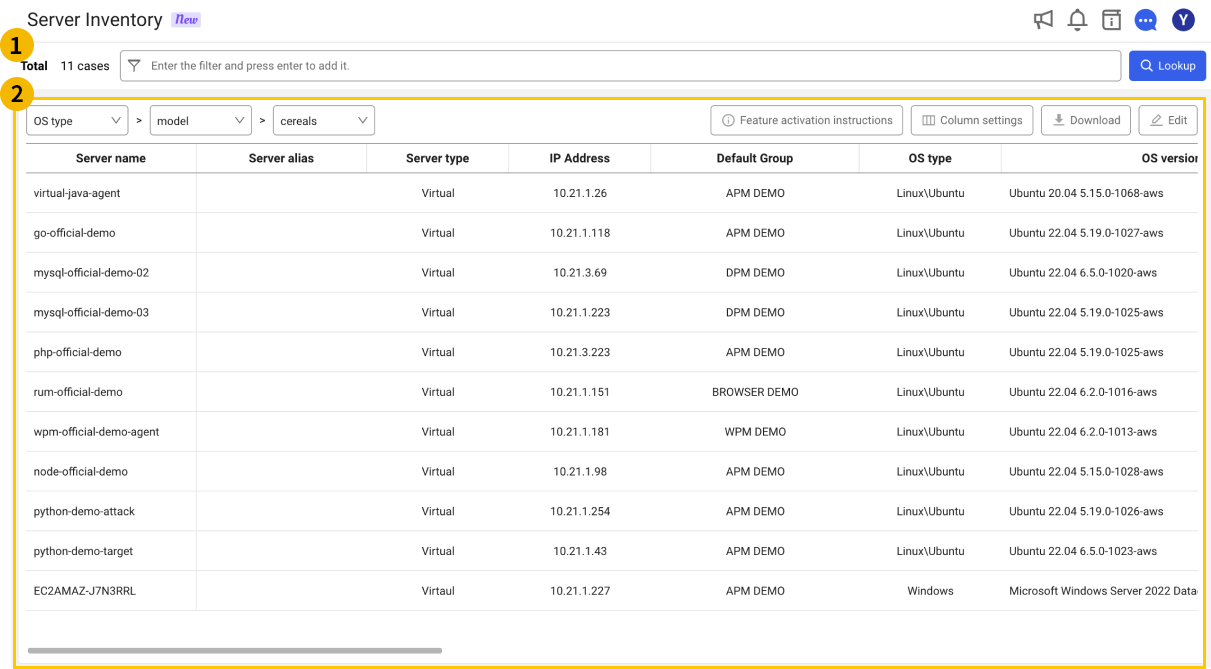
The Server Inventory menu provides key configuration items of the server in a list form. You can manage essential information required for server operation and management, as well as custom items that are automatically collected. This allows server administrators to monitor and operate their infrastructure more systematically and efficiently. Use the filters and sorting feature to easily find the information you need.
Filtering
Click the filter input field, select the desired filter key and condition, enter values, and then click Apply. In the server inventory list area, you can view the filtered list.
-
Filter key: Filters can be set based on the default collection columns provided in the Server Inventory menu and user-defined custom columns.
-
Default collection columns: Items automatically collected from Server Inventory are server type, default group, OS type, OS version, model, and serial columns.
-
Custom columns: They are the items added and managed on a project basis.
-
-
Condition: Filter conditions can be set as numeric conditions such as
≥,≤,>, and<, and string conditions such as Equal, Unequal, Includes, and Excludes.
Align
Sorting options allow up to 3 levels of multi-sorting. You can sort by any desired criteria including custom columns. The default settings for sorting are OS type > Model > Serial.
Sorting is reset when moving and refreshing the menu.
History Lookup
You can track server changes by checking past data in the server inventory, viewing change history, and comparing by date.
Past Data Lookup
You can load snapshot data saved at midnight each day to check past data or the change history of specific fields.
-
Click the YYYY/MM/DD
 button.
 -
Select the past date you want to query, then click the OK button to view the data.
When viewing past data, the Edit, CSV Upload, and Column Settings functions are not available.
The Connection field in the table is automatically hidden.
Change History Lookup
You can check how the value of a specific field in the selected server changed by date during the query period, as well as view creation and deletion history of that field.
-
In Server Inventory, click the
 Change History Lookup button.
 -
In the Inventory Change History Search window, select the date, server, and column name to query.
-
Review the change history by date according to the selected conditions.
Date Comparison
You can compare two dates of a selected server to check data changes and whether fields were created or deleted.
-
Click the History
icon of the server to compare. -
In History Lookup, select the Base Date and Comparison Date to compare the data.
Column Settings
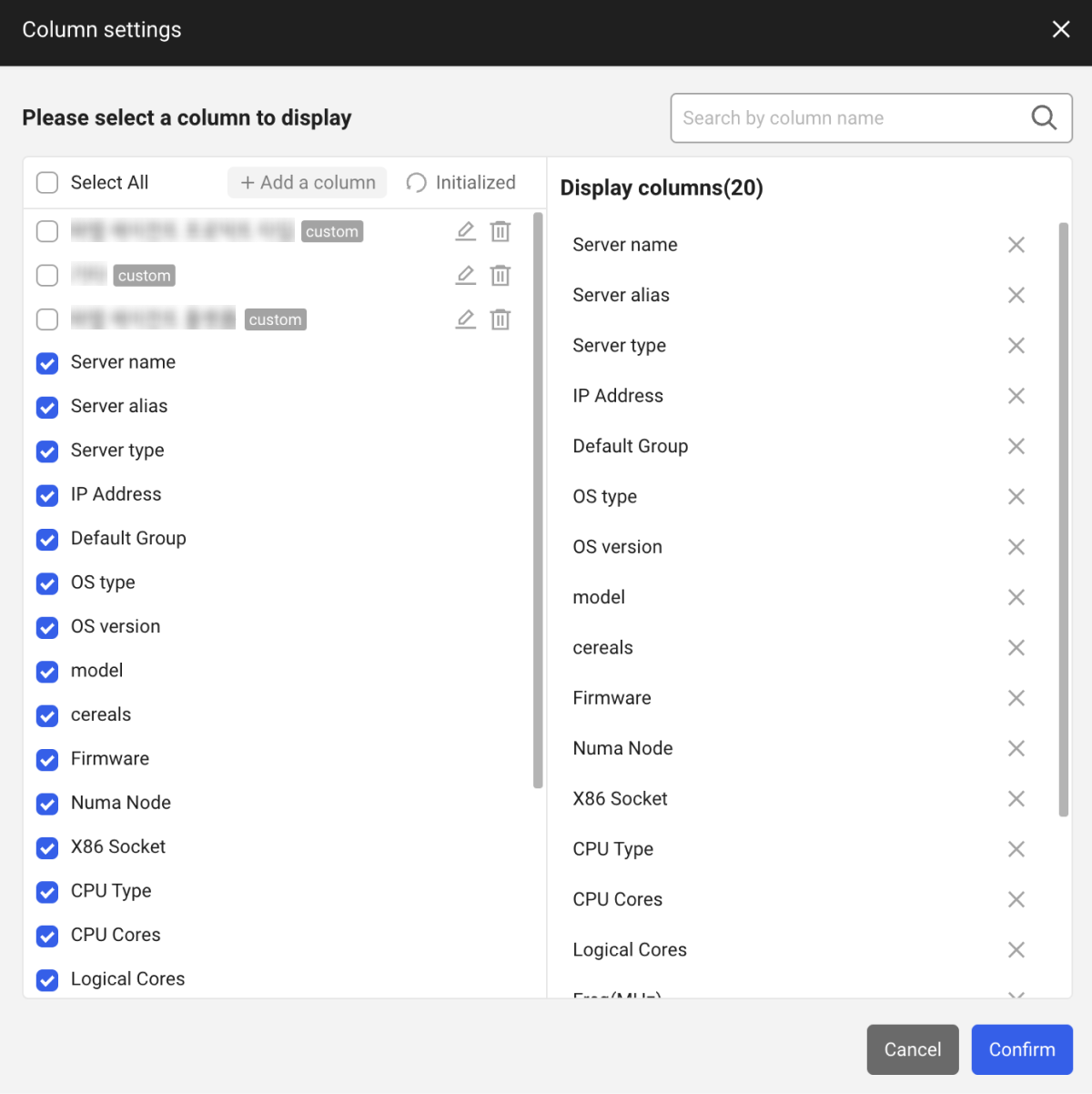
Click  Column settings. Select columns and add custom columns as shown below, and then select Confirm at the bottom to save the column settings.
-
Select Column
Users can select the columns to display in the table. If the Initialized button is selected, it returns to the default selection state.
NoteThe selected columns are saved as browser cookie values and remain in effect even if the page is refreshed. If cookies are deleted or a setting error occurs for any other reason, the default selection state is reset.
-
Adding columns
Users can configure custom columns (
custom) by selecting the + Add a column button and adding their own desired items in addition to the default items. Add columns to your taste and then monitor the server status and performance in more detail.
CSV downloading and uploading
CSV downloading
By selecting the  Download button, you can download the collected server inventory in CSV file format.
CSV uploading
When you need to enter server configuration information in bulk, manually entering individual pieces of data can be time-consuming. The CSV file uploading feature allows efficient handling of bulk data entry. Try modifying the downloaded CSV file and using the upload feature.
-
Click the
 CSV Upload button, then select the CSV file to upload.
 -
Through the CSV verification window, check the verified results for the uploaded data.
-
You can check the numbers of changes and errors.

-
If you click an error, the item in question within the change data list on the right appears, and the erroneous item is highlighted.

-
-
If there is no issue found after verifying the data, click Apply to apply the server configuration information from the selected CSV file.
-
*When uploading a *CSV*, only the changes to Server alias, Default Group and custom columns (
custom) are applied. -
When uploading CSV, the columns that were not previously registered are not reflected.
Modification
Select the  Edit button to edit the server inventory list.
-
You can configure the settings for the Server alias and Default Group columns.
-
You can set the contents of custom columns (
custom) added by users.