Agent installation
This page introduces the WhaTap Kubernetes monitoring agent architecture and the two installation methods. Review the prerequisites and architecture first, then choose the installation method that fits your environment.
Before installing the agent, complete the following steps in the Getting started document.
- Sign up for WhaTap
- Create a cluster project
- Issue an access key
Kubernetes agent architecture
The WhaTap Kubernetes agent consists of master agent pods and node agent pods.
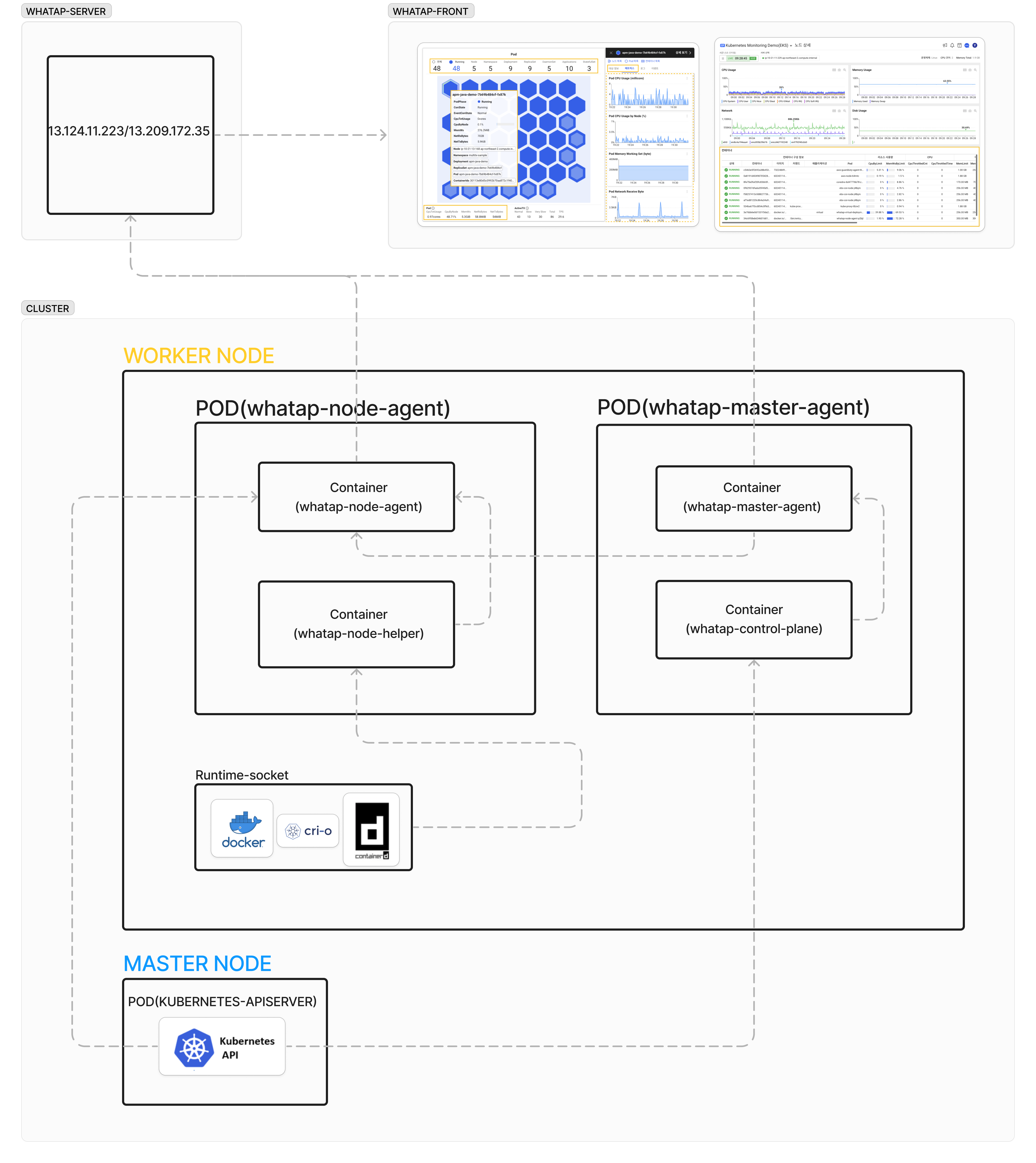
Node agent pod
The whatap-node-agent pod is deployed as a DaemonSet, with one pod running per node. The pod contains the following two containers.
-
whatap-node-agent
Communicates with kube-apiserver to collect metrics for the workloads on the node. These metrics power categories such as
kube_pod,container, andkube_pod_volume. -
whatap-node-helper
Mounts the runtime socket and root volume to collect resource usage of the node and its containers.
Master agent pod
The whatap-master-agent pod is deployed as a Deployment, with one pod running per cluster. The pod includes the following containers.
-
whatap-master-agent (required)
Collects cluster-wide metrics. It also delivers and synchronizes shared data, such as namespace project information, to each node agent.
-
whatap-control-plane (optional)
Collects metrics from Kubernetes control plane nodes. Currently it collects apiserver state and request count metrics. Enabling control plane monitoring requires an additional feature configuration. For details, see the Control plane dashboard document.
In a future release, multiple master agent pods will be able to run simultaneously through a high-availability feature.
Choosing an installation method
WhaTap Kubernetes monitoring supports the following two installation methods. Choose the one that fits your operating environment and management style.
Install with WhaTap Operator
WhaTap Operator is a Kubernetes operator that manages master and node agents, application auto-instrumentation, and OpenAgent through a single custom resource (CR). It continuously watches the CR state and reconciles changes automatically.
See the following pages for installation and configuration.
- WhaTap Operator installation — Deploys the operator with a Helm chart and creates a
WhatapAgentCR. - Application agent auto-injection — Auto-injects APM agents into in-container applications via CR settings.
- OpenMetrics collection with Open Agent — Collects OpenMetrics data from external exporters.
- WhatapAgent CR configuration options — Reference of all available CR settings.
Install master and node agents directly
Deploy master and node agents using YAML or Helm chart by following the Installation guide page in the console. You can choose container runtime, Kubernetes version, and environment options (GKE, OpenShift, etc.) step by step.
Additional application agent installation
Whichever installation method you choose, you need to install application agents separately to monitor Java, Node.js, Python, PHP, or Go applications running inside containers.