Agent Installation
The following guides you to the basic installation method for using the WhaTap database monitoring service.
Checking the configuration diagram
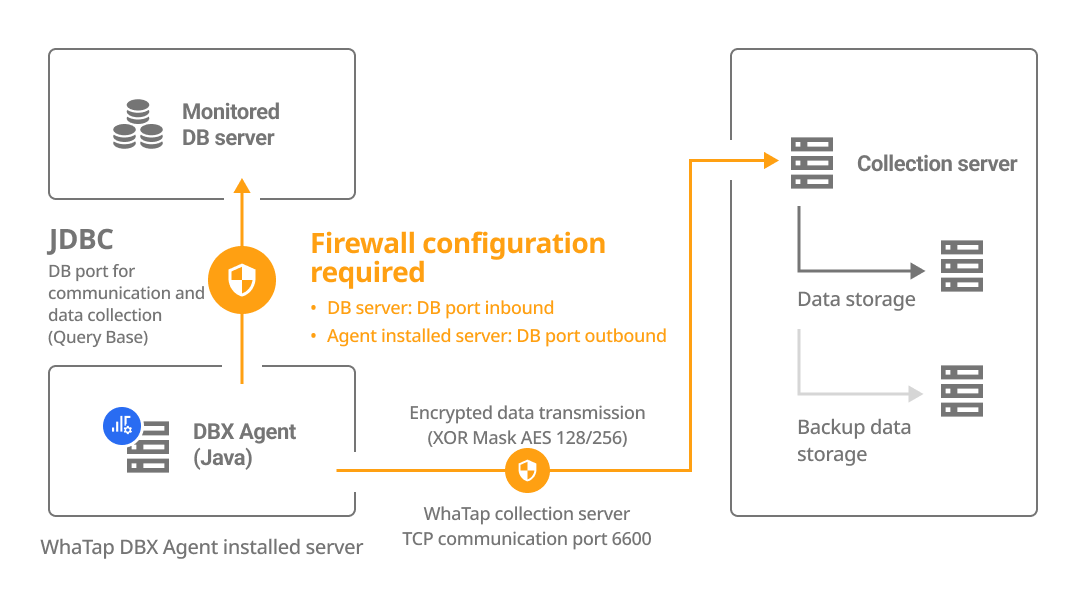
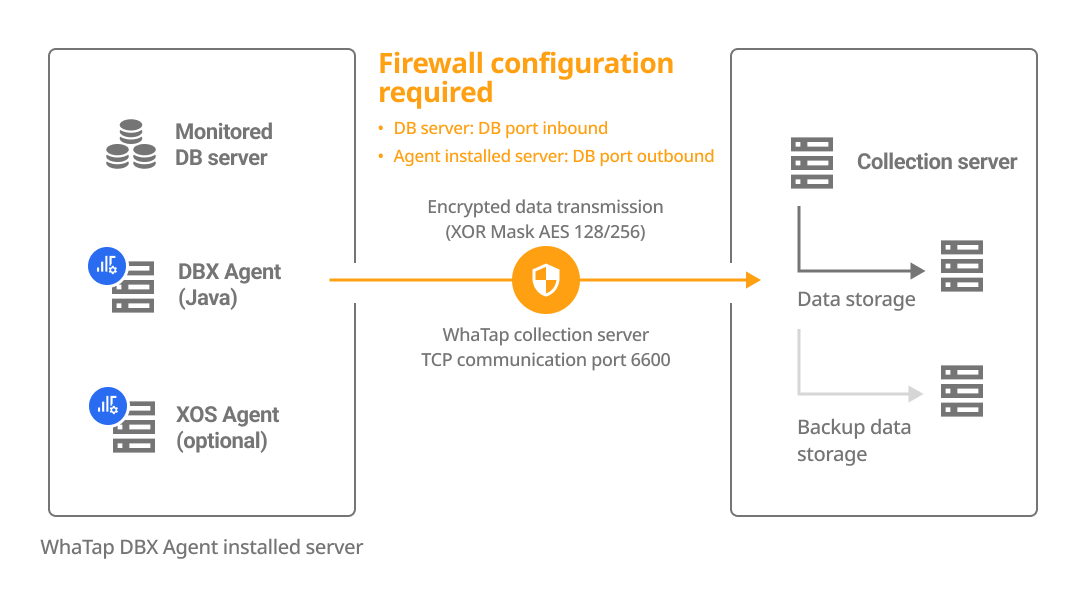
The DBX agent can be installed on a separate server or on the DB server. Select a method how to install the agent and check its configuration and firewall.
| Install on a separate server | Install on the DB server |
|---|---|
|
|
Account creation
Create an account with roles required for database monitoring. Log in with the root account and then create accounts.
create user DB_User with password 'DB Password';
-
If you have an account with roles, skip this step and then proceed to Next Step.
-
In the example code,
DB_Useris the DB user account name. Change it to your account name.
- Enter your password in
DB_Passwordin the example code.
Downloading the DBX agent
Download the DBX agent file. Use the following two methods.
-
You can download it by using the 'wget' command.
BASHwget -O whatap.agent.database.tar.gz "https://service.whatap.io/download/dbx_agent?type=altibase&format=tar.gz" -
If you cannot download it with the command, select Download on the WhaTap monitoring service screen.
Download the DBX agent file and then unzip it.
tar -zxvf whatap.agent.database.tar.gz
For users who cannot download tar files due to security settings, ZIP files are also provided. On the installation screen, select the .zip Download button.
DBX Agent Setting
Follow the instructions on the agent installation screen to configure the agent. By entering the required items on the screen, the configuration and commands can be auto-completed.
whatap.conf configuration
Go to the unzipped folder and then check the whatap.conf file. In whatap.conf, enter the project access key, WhaTap server data, and DB connection data.
license={AccessKey}
whatap.server.host=13.124.11.223/13.209.172.35 # WhaTap server information
dbms=altibase
db=altibase
db_ip={DB_Server_IP}
db_port={DB_Server_Port}
Downloading JDBC
Download the JDBC driver that matches the operating system and version of the database server to the DBX agent path where you unzipped the file. /unzipped folder/jdbc
Altibase JDBC Drivers: http://support.altibase.com/kr/product
In /unzipped folder/jdbc/README.md, you can also see the JDBC driver installation paths for each database.
Creating DB users and changing passwords
Generate an encrypted UID for database connection. Enter the username and password and then run the shell script (or batch file).
When changing the password, enter the new password and follow the same procedure.
- Linux
- Windows
./uid.sh {DB_USER} {DB_PASSWORD}
-
After setting it once, it collects data from the database server to be monitored through the encrypted UID.
-
To create a DB user file, enter the project access key in the whatap.conf file. Checking the access key
-
In the Azure database environment, enter
DB_USERin the form of DB_USER@DB_name. -
If special characters are included in
DB_USERorDB_PASSWORD, enter the escape character (\) together before any special characters.Example./uid.sh whatap whatap\!pwd
# If there are multiple special characters, add the escape character(\) for each.
./uid.sh whatap whatap\!\@pwd
uid.bat "DB_USER" "DB_PASSWORD"
-
After setting it once, it collects data from the database server to be monitored through the encrypted UID.
-
To create a DB user file, enter the project access key in the whatap.conf file. Checking the access key
-
In the Azure database environment, enter
DB_USERin the form of DB_USER@DB_name. -
On Windows, the escape character (
\) is not required for special characters in a password. However, it is required when using double quotes (") within the password.
Viewing the default plan
When creating the default plan user file, you can configure the agent to automatically view the plan by using the predefined DB information.
- Linux
- Windows
-
Add the
plan_dboption to the agent configuration (whatap.conf) file and then enter the DB name.whatap.confplan_db=(dbname) -
After configuring the DB, use the
planuid.shscript to set the user and password../planuid.sh user pwdNoteIf the user (
user) and password (pwd) include special characters, add backslashes (\) before each special character.e.g.
user$example→user\$example
-
Add the
plan_dboption to the agent configuration (whatap.conf) file and then enter the DB name.whatap.confplan_db=(dbname) -
After configuring the DB, use the
planuid.batscript to set the user and password.planuid.bat user pwd
Starting the monitoring
Execute a shell script (or batch file) from the path where you have installed the agent.
- Linux
- Windows
./start.sh
To use it like a daemon, execute the following command. However, it works only in the environment where nohup has been installed.
./startd.sh
start.bat
Check whether there are any errors in the execution log displayed on the screen, and check whether a chart appears normally on the dashboard screen (Instance List). If there is no problem, press Ctrl+C to terminate the execution, and then register it as a Windows service in the following order.
Registering a service
Execute the following command to register a service.
install_WindowsService.bat create WhatapDBXAgent
When a service is registered, you can check it in the service management tools as shown below. Find the service, right-click it, and then select the Start option to start the service.
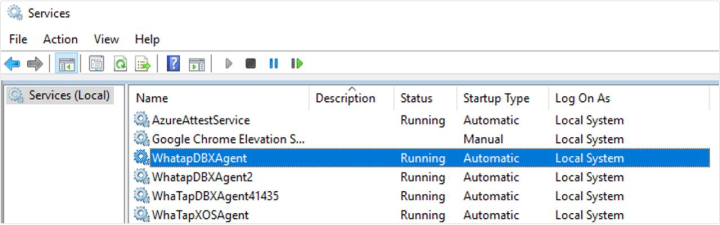
In Control Panel > Windows Tools > Services (services.msc), you can start or stop the WhatapDBXAgent service. Depending on the Windows version, the service path may differ.
Deleting a service
Execute the following command to delete a service.
install_WindowsService.bat delete WhatapDBXAgent
You completed installing the agent for database monitoring. In the following, check the post-installation checklist.
Installing the additional agent (XOS) and applying other options
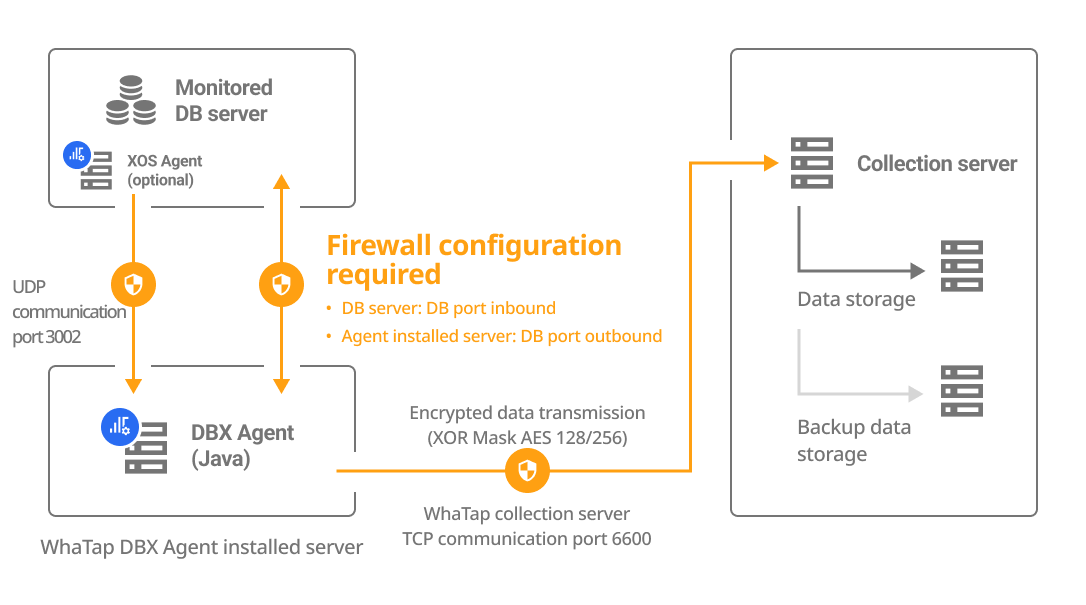
To additionally monitor the resources of the database server, run a separate XOS agent process on the database server to collect data.
-
It can be applied to only the OS environment running on the x86 architecture.
-
The additional agent installation process is optional.
- For more information about the XOS agent configuration options, see the following.
Configuring the whatap.conf file
Set the following options in the whatap.conf file in the path where the DBX agent has been installed.
xos=1
xos_port=3002
Move the xos folder (/unzip folder/xos/) to the database server.
Configuring the xos.conf file
Set the following options in the xos.conf file in the xos path moved to the database server.
dbx_ip={DB_Agent_IP}
dbx_port=3002 # default 3002
cpu_limit=0
mem_limit=10240
In Agent Installation, when you enter the DB data to DB Agent IP and DB Agent Port, the agent options are automatically generated.
Running the XOS agent
- Linux
- Windows
Run the XOS agent.
./start.sh
-
To transmit monitored data to the DBX agent, the port set to
dbx_port(default 3002) must have been open. (UDP Outbound) -
To run the XOS agent in the background, run the ./startd.sh file.
Run the agent with a batch file in the xos folder.
start.bat
After confirming that there are no errors in the execution log displayed on the screen and terminating the execution, register for the service in the following order.
How to fix missing of msvcp120.dll and msvcr120.dll
If you cannot run the xos agent because the msvcp120.dll and msvcr120.dll files are missing, it is because Microsoft Visual C++ 2013 Redistributable 2013 is not installed or is corrupted. You can resolve this issue by installing the Microsoft Visual C++ 2013 Redistributable Package.
Download and install the package that matches the system environment from the following link.
Microsoft Visual C++ 2013 Redistributable (x64)
- vcredist_x64.exe: For running 64-bit applications
-
Service registration
Register in the service by running the install_WindowsService.bat file in the xos folder as follows. If you do not enter a name after the
createoption, the service is registered by default with the name of WhatapXOSAgent.install_WindowsService.bat create WhatapXOSAgent -
Deletion of a service
install_WindowsService.bat delete WhatapXOSAgent
To transmit monitored data to the DBX agent, the port set to dbx_port (default 3002) must have been open. (UDP Outbound)
Next steps
-
Checking the installation
If you have created a project, installed an agent, and applied all agent options, see the checklist in the following.
-
Installation troubleshooting
It provides various problems that may occur when installing the agent and specific instructions for resolving them. For more information, see the following.
-
Agent setting
It provides various features for monitoring by applying some options to the agent configuration file (whatap.conf). For more information, see the following.
To additionally monitor the database server resources, set more options in the additional agent (XOS). For more information, see the following.
-
Starting the monitoring
After configuring all settings, the agent starts collecting metrics data from the database server. First, check whether the monitoring data has been collected in Instance List. For more information about Instance List, see the following.